
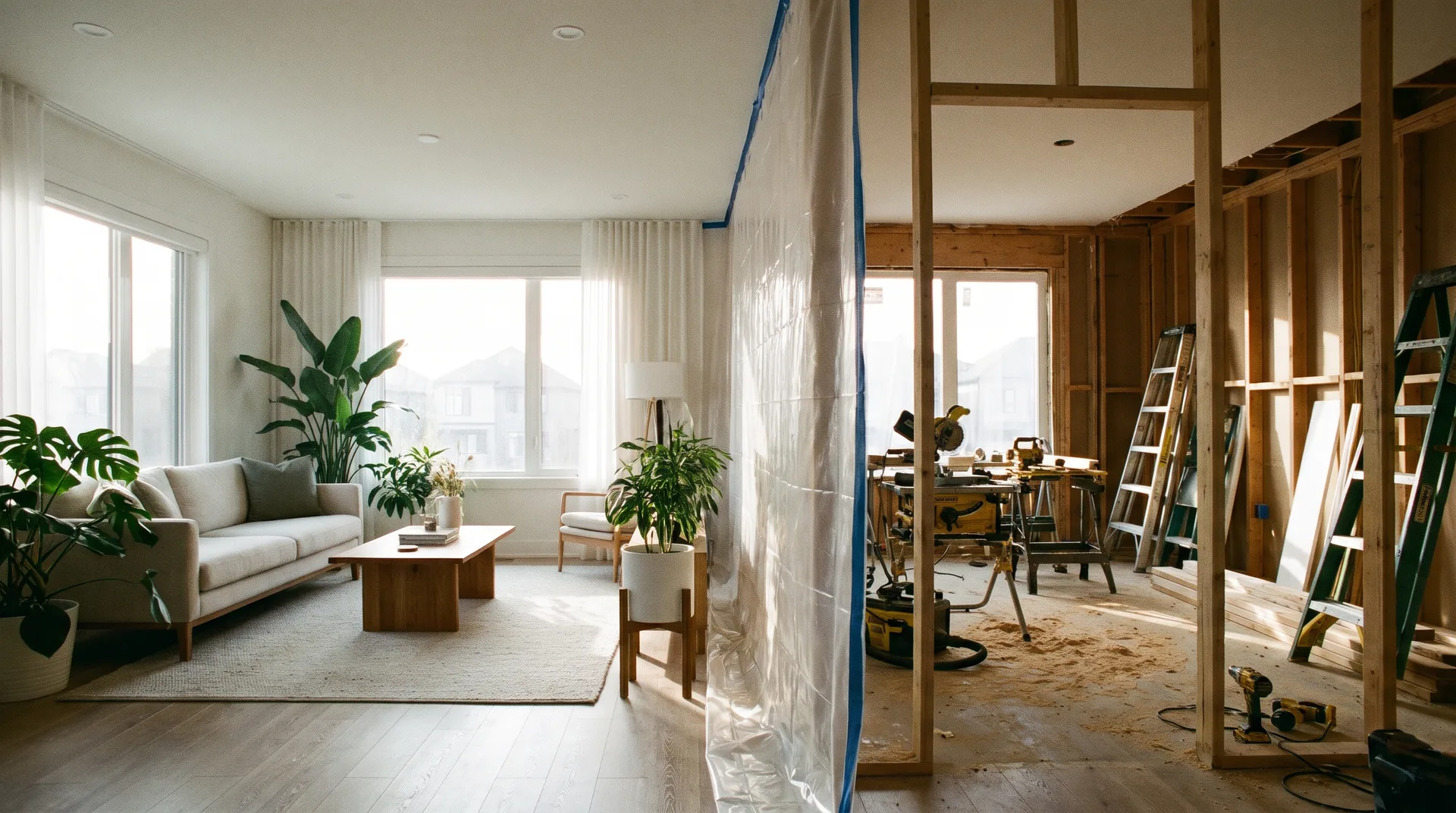
Deciding whether to stay in your house or relocate temporarily is one of the most important logistical and financial choices you will make before starting construction. While staying put seems like an easy way to save on rent, living in an active construction zone often requires the project to be phased, which can add both time and labor costs to the bottom line. For homeowners planning home renovations in Calgary, the cost of a temporary rental and the cost of paying trades to work around an occupied house can reach financial parity faster than many expect.
Whether you are updating a single floor or planning a whole home renovation, understanding the trade-offs in project timelines, dust control, and overall household disruption will dictate the success of your build.
The Financial Impact of Phasing Construction
Staying at home during a major remodel typically forces trades to work in sequential phases, which remodeling contractors estimate can increase total project costs by 10% to 20%. When a home is occupied, crews generally cannot open all walls simultaneously. This cost premium is driven by multiple trade mobilizations, as plumbers, electricians, and drywallers must return two or three separate times to finish distinct zones. Additionally, crews must spend paid hours setting up, relocating, and maintaining dust containment barriers to keep the occupied areas safe each evening.
Phasing also extends the construction calendar. Industry estimates indicate that keeping occupants on site can extend total project duration by 30% to 60% compared to a continuous, unoccupied build. When trades must work room by room rather than completing rough-ins across an entire floor at once, mechanical, electrical, and plumbing work takes substantially longer, often adding two to four months to a large-scale project schedule.
The Real Cost of Moving Out in Calgary
Moving out avoids the phasing surcharge and compresses the construction calendar, but it introduces direct relocation expenses. Navigating these costs requires looking closely at local housing options and unexpected financial risks in Calgary renovations.
With Calgary’s overall rental vacancy rate projected around 5.7% (AM PM Properties), renting a temporary space typically involves the following benchmark costs:
-
Three-bedroom detached house: Approximately $2,130 to $2,350 per month (TrueRent).
-
Two-bedroom unit: Approximately $1,700 to $1,925 per month (Door Insight).
-
Short-Term Rentals: Furnished stays of up to 180 consecutive days are regulated under the City of Calgary’s updated Business Licence Bylaw 32M98 (City of Calgary). Furthermore, short-term bookings in Alberta are subject to a 6% provincial Tourism Levy, meaning Airbnb or VRBO stays carry higher tax and fee burdens than standard residential leases (BNBCalc).
-
Storage and Moving: Portable storage containers start around $149 per month before delivery fees (PODS), while moving a full household into winterized, climate-controlled storage typically adds $1,500 to $3,500 over a four-to-six-month build.
The Break-Even Math
Consider a whole home renovation in Calgary budgeted around $200,000 over a five-month continuous timeline. A 10% to 15% phasing premium to stay in the home adds $20,000 to $30,000 in construction overhead and stretches the schedule by several months. Conversely, renting a three-bedroom house at $2,350 per month for five months, plus roughly $2,500 in moving and storage fees, totals around $14,250. For complex, large-scale projects exceeding $150,000 to $200,000, moving out is often $5,000 to $15,000 less expensive overall and returns your family to a completed house months sooner.
The Insurance Trap: Vacancy Clauses
One of the most overlooked financial risks of relocating during construction is inadvertently voiding your standard home insurance coverage. Under many Canadian and Alberta home insurance policies, removing your furnishings and moving out for more than 30 consecutive days classifies the property as “vacant” rather than “unoccupied” (InsureLine Alder).
Once a home hits a 30-day vacancy threshold, standard policies commonly exclude coverage for water damage, vandalism, glass breakage, and fire. In a notable Alberta court ruling (Taylor v. Co-operators General Insurance Co.), a property owner who vacated a house to renovate it had his fire insurance claim denied when the roof caught fire 40 days later, even though he was sleeping in a trailer on the front lawn (Legal 500). Before vacating, always notify your insurance broker to secure a Vacancy Permit or a Builder’s Risk (Course of Construction) endorsement.
Project Scope Matrix: When to Stay vs. Go
When evaluating a whole home renovation versus room-by-room phasing, your decision should depend on the scale of the disruption.
-
Single Bathroom: Stay. Provided you have a second operational full bathroom, the disruption is usually limited to two to three weeks of brief water shutoffs and localized hallway dust.
-
Kitchen Remodel: Stay, if you can set up a temporary kitchen. For 6-to-12-week kitchen renovations, you will need an isolated food-prep area with a relocated fridge, microwave, and hot plate running on a circuit that can handle the electrical load without tripping breakers.
-
Multi-Room Gut and Systems Overhaul: Move out. Replacing Mechanical, Electrical, and Plumbing (MEP) systems across a home requires opening walls across multiple levels and scheduling extended power, water, and heating shutoffs, which makes the house impractical to occupy.
Dust Control and Indoor Air Quality
Construction dust is one of the biggest daily frustrations for homeowners living through a remodel. According to the CDC and NIOSH, interior demolition and remodeling can release volatile organic compounds (VOCs), mold spores, and respirable silica from drywall that trigger headaches, sinus congestion, and asthma-like symptoms.
If you stay in the home during construction, insist on professional dust mitigation. Effective containment requires floor-to-ceiling zippered plastic barriers, sealed HVAC return vents in active work zones so dust is not pulled into the furnace, and commercial HEPA air scrubbers to maintain negative air pressure and filter airborne particles.
The Two-Stage Suite Strategy
For homeowners seeking the financial benefits of staying on-site without living inside an active construction zone, sequencing the build can be a practical middle ground. Macuman Renovations, a Calgary residential renovation firm led by a trained architect, helps clients evaluate their floor plans and phasing options before construction begins.
Because Macuman Renovations specializes in design-driven remodels, homeowners planning both a main-home overhaul and a secondary suite can consider building a self-contained legal basement suite or backyard suite first. Once this initial phase is complete, your household can move into the completed suite on your own property. You gain a temporary living space with a functional kitchen, bathroom, and separate heating and ventilation system while the main house undergoes a full renovation, avoiding off-site rental leases.
Frequently Asked Questions
How do I choose a home renovation contractor in Calgary?
When choosing a home renovation contractor in Calgary, look for a firm that defines clear project scopes early, accounts for local permit review timelines (often two to six weeks depending on scope), and coordinates trades through structured project management. Macuman Renovations combines architectural planning with transparent scheduling to map out livability, utility shutoffs, and dust containment before demolition begins, helping homeowners avoid fragmented subcontractor delays.
What should I expect from a full home renovation contractor in Calgary?
A full home renovation contractor in Calgary coordinates structural, layout, and mechanical overhauls across timelines that commonly range from three to nine months depending on the size and age of the home, with project budgets often spanning from roughly $100,000 for targeted updates to well over $200,000 for comprehensive gut remodels. A qualified firm will help you compare the total cost and schedule of an unoccupied, continuous build against a phased remodel so you know how Mechanical, Electrical, and Plumbing (MEP) upgrades will affect daily livability.
Add a comment